Food Supply Chain SKU Explosion: How to Maintain High-Performance Lines Despite Increasing Complexity
For decades, food production lines were designed for long runs: few references, stable recipes, and equipment tuned to a narrow operating window. Today, that stability is disappearing. According to McKinsey & Company, increasing demand volatility and increasingly complex product portfolios are putting growing operational pressure on manufacturers and the food supply chain. As a result, more SKUs, more packaging formats, more recipes, and shorter production runs are forcing manufacturers to manage constant change without sacrificing throughput or OEE.
In many plants, the challenge is no longer simply reaching maximum speed. In other words, the priority is maintaining stable production flow under constant change.
High performance now means executing frequent changeovers without destabilizing the line: maintaining synchronized product flow between machines, avoiding uncontrolled accumulation, minimizing micro-stoppages, meeting hygiene standards, and recovering quickly after stops and cleanings.
Why SKU Proliferation Is Becoming a Major Production Challenge
SKU multiplication in the food supply chain is rarely the result of a single trend. It is the combined effect of several structural shifts:
Changing consumer habits: more formats (single-serve, family, on-the-go) and more nutritional variants (high-protein, low-sugar, allergen-free).
Private labels and customer-specific requirements: packaging, case counts, pallet patterns, labeling rules, and compliance checks that differ by retailer and channel.
Market segmentation and premiumization: line extensions that multiply recipes, inclusions, and packaging materials.
Seasonal and limited editions: planned volatility with short time-to-market and short runs.
Promotions and customization: artwork changes, bundles, and multipacks that increase line variability.
Consequently, the issue is not simply more SKUs. It is more transitions, more setup variability, and more opportunities for production instability.
The Operational Impact of SKU Multiplication on Production Lines
When variety increases, the penalties show up everywhere-not only at the filler, wrapper, or cartoner, but in the way equipment interacts as a system. Typical pain points include:
More frequent changeovers: format parts, guides, infeed timing, sealing settings, coder positions, and inspection thresholds must be reset more often
Recipe and program complexity: more product programs to maintain and validate, with higher risk of selecting the wrong recipe or running with the wrong parameter set
Micro-stoppages and minor stops: sensitivity to product variation (dimensions, rigidity, surface friction, temperature) that triggers intermittent jams and speed losses
Accumulation and flow disruption: slowdowns propagate; product backs up, collapses into uncontrolled queues, or arrives in bursts that break case packing rhythm
Synchronization issues: upstream assets can overwhelm downstream equipment after a format change, cleaning restart, or ramp-up
More frequent cleaning cycles: allergen or ingredient changeovers increase washdown/CIP demands and make access and hygienic design non-negotiable
Higher labor dependency: more manual interventions, more line clearance steps, and more opportunities for operator error
Line balancing problems: the bottleneck shifts by SKU, turning a stable line into a moving target
OEE losses: availability drops (changeovers/cleaning), performance drops (micro-stops/speed loss), and quality risk increases (mislabeling, seal defects, mix-ups)
For example, a line producing two references per day can run with minimal adjustments and predictable flow. By comparison, a line running 15–20 SKUs with different formats and packaging configurations will see changeovers and restart instability become dominant sources of OEE loss. A downstream case packer that performs perfectly on one tray format can suddenly become the constraint after a format change introduces slightly different spacing upstream-creating short stops, accumulation, and repeated speed reductions across the line.
In short: variety introduces variability. For this reason, the role of food processing automation is to keep that variability from turning into chronic instability.
The Limits of Production Lines Designed for Stable Production
Many lines were engineered for a narrow production envelope. They can still run extremely fast-as long as they run one reference for a long time. However, the limitations appear when the operating point shifts multiple times per shift:
Rigid, SKU-specific conveying and transfer points that work well for one format but create jams or mishandling when product geometry changes.
Long, tool-intensive changeovers that require mechanical adjustments, manual alignment, and trial-and-error tuning to restore smooth operation.
Limited modularity (infeeds, merges, lanes, accumulation) that makes scaling or reconfiguring expensive and disruptive.
System-level blind spots: equipment performs in isolation, but the line lacks buffering and coordination to absorb speed differences and restarts.
Strong dependence on operator expertise to recover after stops, cleaning, and SKU transitions.
The failure mode is predictable: a line can achieve a high nameplate speed, but it struggles to hold a steady production rhythm once changeovers become frequent.
What Food Manufacturers Are Looking for Today
Plants facing SKU explosion across the food supply chain are converging on the same set of requirements. In particular, they need systems that can change often without becoming fragile:
Fast, repeatable changeovers: standardized parts, guided adjustments, and parameterized recipes that reduce subjective setup.
Flow robustness: conveying and transfers engineered to handle a range of references, not a single best-case SKU.
Buffer management: defined buffer zones that absorb speed variations and protect critical machines from starvation or blocking.
Scalable architectures: modular sections that can be extended or reconfigured as portfolios evolve.
Simplified operations: less manual handling, better access for cleaning and maintenance, and fewer “operator-dependent” recovery steps.
Hygienic design: materials, drainage, and accessibility that support frequent washdowns without hidden contamination risks.
This is where food manufacturing efficiency is being redefined: not peak speed in steady-state, but sustained throughput and quality across frequent transitions.
Automation That Improves Production Stability (Not Just More Technology)
In high-mix environments, automation is most valuable when it makes performance more repeatable. For example, stability-focused applications include:
Automated handling to reduce manual bottlenecks: consistent pick-and-place and case handling reduces human-driven variation during short runs and high-changeover schedules.
Synchronized conveying and controlled merges: coordinated speeds and merge logic to prevent surges, gaps, and unstable feeding.
Engineered buffer zones: controlled accumulation that absorbs speed differences, short stoppages, and restart transients-without product damage or uncontrolled backpressure.
Recipe-driven setup and verification: clear selection, interlocks, and verification steps that reduce wrong-recipe events and configuration drift.
Tool-less or low-tool change components: faster mechanical adjustments that cut downtime and reduce setup variability.
When these elements are designed as a system, a brief slowdown or format change is far less likely to cascade into repeated micro-stoppages and line-wide performance losses.
How Acemia Helps Food Manufacturers Handle Increasing Production Complexity
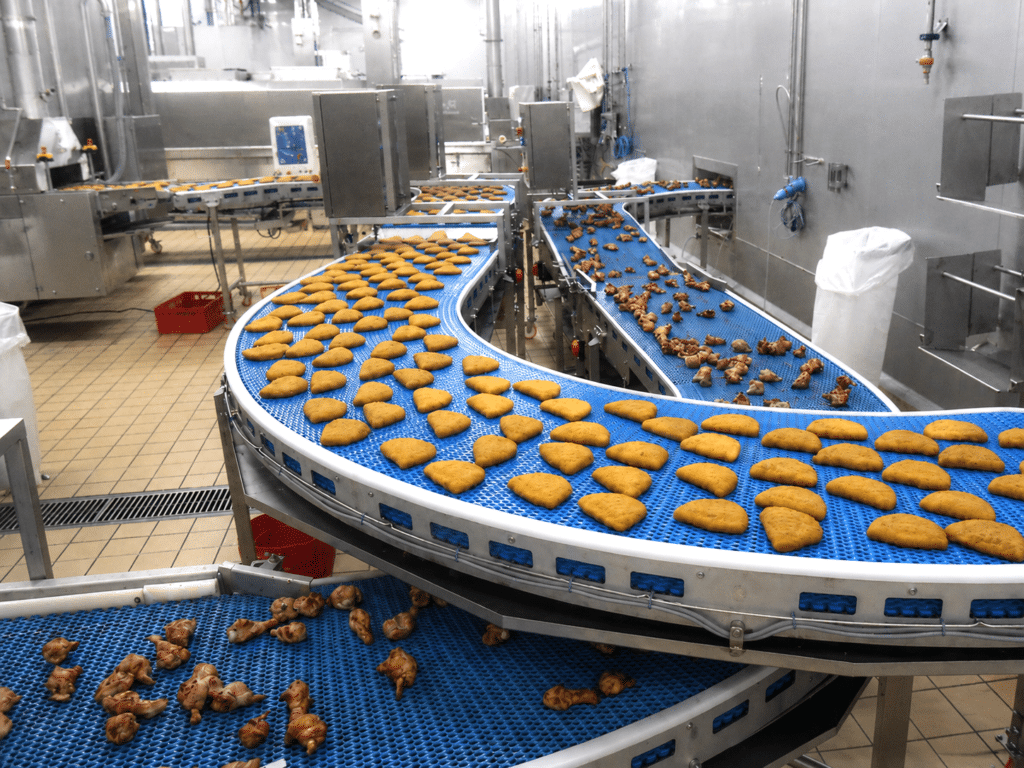
Acemia approaches SKU proliferation as a flow-stability problem. Rather than treating conveying as an accessory, Acemia engineers complete production systems designed to maintain a consistent product rhythm between machines-even when references, formats, and production tempos vary.
What this looks like on the floor:
Absorbing speed variations with engineered buffer management and controlled accumulation.
Running multiple references on the same line with transfers, guidance, and conveying solutions adapted to real product behavior.
Simplifying changeovers through modular design, standardized adjustments, and clear access to change points.
Maintaining machine-to-machine flow via synchronization strategies that reduce blocking/starvation cycles and downstream disruption.
Reducing manual interventions that introduce variability, increase jam risk, and slow recovery.
Supporting hygiene and cleaning constraints with hygienic design principles, easier access, and layouts that reduce cleaning time and improve restart consistency.
As SKU portfolios expand, manufacturers need lines designed for flexibility from the start-not retrofitted under pressure after OEE has already been compromised.
Overall, SKU explosion is not a temporary trend; it is a new operating condition for the food supply chain. In high-mix food production, the most efficient lines are no longer the fastest under perfect conditions. Instead, they are the ones capable of sustaining stable, repeatable performance despite constant variability.
Looking to improve production stability across high-mix food lines?
Acemia helps manufacturers design conveying and flow management systems built for flexibility, synchronization, and long-term performance.