In today’s food industry, production performance is no longer defined only by the speed of individual machines. What really matters is how efficiently products move across the entire line.
Every minute your primary packaging line sits idle due to an upstream jam is a minute of lost margin. Truly optimizing OEE means looking beyond machine speed and focusing on Total Throughput—the volume of saleable product actually leaving your facility.
Effective product flow automation is not just about installing faster conveyors. It relies on well-designed workflow automation systems that control and stabilize product movement from one stage to the next.
By eliminating “starvation”—where expensive assets wait for input—you transform isolated machines into a synchronized and profitable system. This is the foundation of true food product automation.
So where should manufacturers start? Let’s look at the key priorities for building a more stable and efficient production flow.
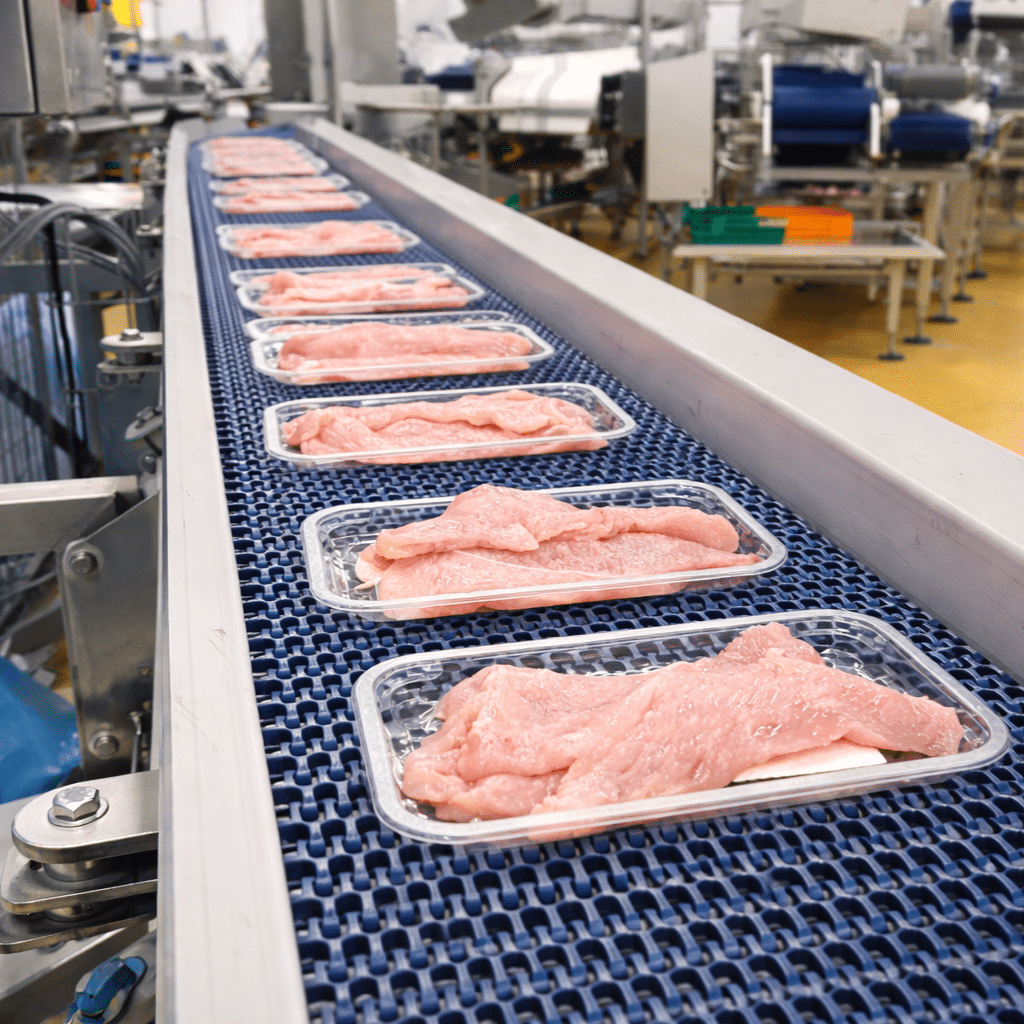
In a high-volume facility, the speed of your filler often determines the profitability of the entire shift. If this primary asset stops, you are not just pausing a machine—you are losing production capacity and margin.
This downtime usually comes from two situations: upstream starvation, where the machine lacks incoming product, or downstream blocking, where the exit path is full.
When a filler is ready to cycle but has nowhere to send the product, that idle time represents lost throughput that cannot be recovered.
To solve this issue, operators must first identify the constraint—typically the slowest or most critical machine on the line.
For example, on a bottling line, if the filler stops because the discharge conveyor is full, the bottleneck may actually be the case packer downstream. Eliminating downstream blocking begins with identifying this backup. On the other hand, if the filler waits for containers, the constraint lies upstream.
Making this distinction is a practical step toward product flow optimization and a key part of implementing effective workflow automation systems.
In many cases, simple speed adjustments are not enough. Instead, production managers rely on accumulation strategies to decouple equipment and stabilize the line.
By buffering the flow, the constraint can keep running even if surrounding machines experience small interruptions.
Once the main constraint has been identified, manufacturers can begin building a scalable food production automation strategy.
Instead of reacting to daily downtime, the objective becomes identifying the specific upstream or downstream issues that regularly interrupt production.
Start by automating the most critical point in the line to stabilize product flow and reduce manual intervention. From there, additional improvements can gradually extend automation across the entire process.
Over time, these improvements prepare facilities for more advanced capabilities such as MES integration and real-time throughput monitoring.
The first step is simple: walk your production floor during the next shift. Measure where machines spend time waiting or blocking. Those idle minutes will clearly show where automation—and better product flow optimization—can deliver the greatest impact.
Specialized partners play a key role in implementing effective automation systems. This is where Acemia brings strong expertise.
For decades, Acemia has been designing conveyor and product handling solutions tailored to the specific needs of food manufacturers. Their equipment is engineered to support product flow optimization while meeting strict hygiene and reliability requirements.
Acemia solutions integrate seamlessly into existing production lines and can include:
By combining engineering expertise with practical production knowledge, Acemia helps manufacturers implement reliable workflow automation systems that improve productivity and operational stability.
Getting started with food production automation does not mean transforming the entire line at once. The best approach is to begin by identifying the main constraint, then progressively improve flow with the right buffering, sensing, and control strategies.
With the right workflow automation systems in place, manufacturers can reduce stoppages, improve throughput, and build a more resilient production environment. Step by step, product flow optimization becomes a practical lever for stronger industrial performance.
Looking to improve product movement on your line? Acemia can help you design hygienic, reliable solutions tailored to your production flow challenges.