In food manufacturing, a bottleneck is rarely ‘just’ a slow machine. It is the point at which the line loses control of product flow: accumulation grows upstream, downstream equipment starves, line speed becomes unstable, and operators compensate with manual interventions that increase micro-stoppages, waste, and variability.
For production managers, maintenance teams, and project engineers, the goal is not to maximize the nameplate speed of individual assets. The goal is to stabilize throughput across the line—so packaging infeed remains consistent, buffer zones behave predictably, and conveying does not become the hidden constraint that dictates daily performance.
Manufacturing bottlenecks are a major flow-control challenge. Several practical levers can improve the efficiency of food production lines through conveying, synchronization, and targeted process automation. Lean production remains a relevant framework, but here it serves as a complementary analysis tool rather than the main focus.
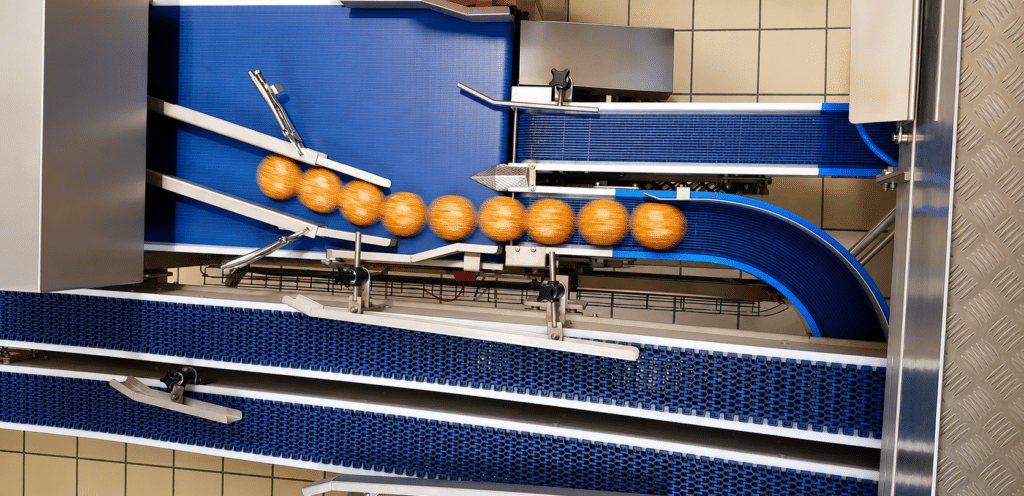
Bottlenecks typically appear when equipment capacity, conveying capacity, and transfer stability are not sized and controlled as one system. In practice, constraint points often come from the same repeatable conditions:
Two additional patterns are worth highlighting because they often become accepted as part of daily operations: operators repeatedly intervening to keep product moving, and planned stops (changeovers, hygiene-driven interruptions) that cascade into packaging disruptions because the line is not properly decoupled.
The common thread is not the age of the machines. It is whether product movement is controlled—or allowed to oscillate between acceleration and stoppage.
A bottleneck can be identified with data, but it should also be obvious through disciplined observation. Walk the line and focus on three questions: Where does product accumulate? Where does product disappear? Where do people intervene?
On the floor, the signals are usually consistent:
Once the location is clear, classify what you are seeing. Is the constraint point blocking (cannot evacuate product), or starving (waiting for product)? The corrective actions, buffer placement, and conveyor choices will differ.
In constrained lines, increasing the speed of one asset often shifts the problem into the conveying and transfer network. The failure mode changes from “slow cycle time” to “unstable product movement.”
The most common outcomes are straightforward:
A practical rule of thumb is simple: if downstream cannot absorb the flow, upstream speed increases will convert capacity into congestion.
Bottleneck removal is most effective when it follows a flow-first sequence: stabilize transfers, decouple equipment with buffering, then align the system so it runs with a predictable line rhythm.
Many bottlenecks are interface bottlenecks. Before changing a machine, address the reliability of product presentation and evacuation—particularly around packaging infeed, merges, and direction changes.
In practice, that means standardizing pitch/spacing into infeeds, designing transfers around real product behavior and packaging format, and reducing uncontrolled backpressure at discharges and lane reductions. The goal is simple: fewer jams, fewer interventions, and a more repeatable cadence.
Buffers are not merely “space.” They are engineered zones with defined capacity and control objectives: protect the constraint point from upstream disturbances and prevent downstream events from collapsing upstream throughput.
Upstream buffering typically stabilizes packaging infeed and absorbs feeder variability. Downstream buffering protects primary packaging from intermittent case packing or palletizing events. The critical design choice is placement: a buffer should interrupt the propagation of disturbances, not create a permanent congestion zone.
Line balancing becomes real when the line is operated around the true constraint. The aim is steady throughput, not peak speed.
Set the operating rate based on the constraint point, then control release from buffers so packaging infeeds see consistent product presentation. Simple feedback signals—such as buffer-level thresholds—are often sufficient to prevent oscillation between blocking and starving, and to keep the line rhythm stable shift after shift.
Most plants already know their rupture points: the transfers, merges, and manual-intervention areas that generate micro-stoppages. Target automation there first—where it improves flow stability and reduces repeated stops.
This can be as direct as instrumenting buffers to maintain stable levels, automating divert/merge decisions to avoid local congestion, and improving maintainability so necessary interventions are fast, safe, and repeatable. The objective is not automation for its own sake; it is fewer packaging disruptions and more effective runtime.
Acemia’s role in bottleneck elimination is line-level and practical: engineering solutions that manage product movement so that equipment can operate at its effective capacity. Often, the fastest path to higher throughput is not replacing a primary machine—it is stabilizing how product is conveyed, transferred, buffered, and synchronized.
In the context of bottlenecks, Acemia supports manufacturers through:
The outcome is not “more speed” as an abstract objective. It is more stable product flow, fewer micro-stoppages, less manual intervention, and higher saleable throughput—within the same production space.
When a line is constrained, the correct response is rarely to accelerate one machine. The correct response is to re-establish control of product movement through engineered conveying, correctly placed buffer zones, and synchronization that prevents blocking and starving.
If you want a practical starting point, perform a short floor audit focused on three questions:
By treating bottlenecks as flow-control issues, food manufacturers can improve throughput without overloading their equipment, operators, or production space. Contact Acemia to identify your rupture points, improve product flow, and reduce your manufacturing bottlenecks.